Solar for Better Life (SOBEL)
Expanding access to solar energy solutions to improve livelihoods and services in rural communities.
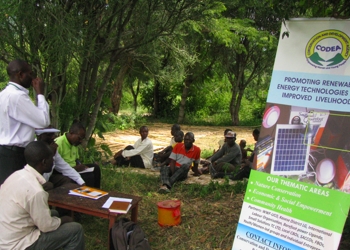
Increasing sustainable access to clean energy services for rural households and institutions in Kasese District.
Access
to clean, reliable, and affordable energy remains a major challenge in Uganda,
particularly in rural communities where millions of households still depend on
firewood, charcoal, kerosene, and candles for cooking and lighting. According
to national energy trends, the majority of rural households continue to rely on
biomass energy, contributing to rapid deforestation, environmental degradation,
indoor air pollution, and poor household health outcomes. In regions such as
Rwenzori, limited access to electricity has continued to affect education,
household safety, small businesses, and overall community productivity. Women
and children are often forced to walk long distances in search of firewood,
while children in off-grid households struggle to study effectively at night
due to poor lighting conditions. These challenges continue to deepen poverty
and limit opportunities for sustainable livelihoods among vulnerable rural
households.
In
response, CODEA implemented the Solar for Better Life Project to promote access
to clean, affordable, and sustainable solar energy solutions among vulnerable
communities in the Rwenzori region. The project strengthened community
awareness on renewable energy and environmental conservation while promoting
adoption of solar technologies to improve household lighting, safety,
education, and livelihoods. Through community sensitization, capacity building,
and support for clean energy alternatives, households were able to reduce
dependence on kerosene and biomass energy, lower energy-related costs, improve
indoor living conditions, while in the long run strengthens environmental
stewardship. The project further contributed to improved resilience, and better
wellbeing for vulnerable families living in underserved rural communities. The
efforts and partnerships are still needed to expand access to clean energy
technologies and accelerate the transition toward sustainable and
climate-resilient livelihoods.